


Momentous "Fairness For Every Generation Budget" Collides With Cynicism About Politics
Not everyone is throwing the baby out with the bathwater

You’ve heard a lot from us of late on why Ottawa’s decision to name generational fairness in the budget matters for shaping Canada’s future. But it’s likely this isn’t a message you’re hearing from others.
It’s discouraging that some political pundits are glossing over the budget’s core theme as more-of-the-same from a government that’s talked about fairness for years; or dismissing it outright as a tactic to recapture dwindling youth support. Pollsters meanwhile are focused on the fact that the budget hasn’t (yet?) curried favour with younger voters, suggesting that ‘fairness for every generation’ is an electoral flop.
They couldn’t be more wrong. In fact, they are entirely missing the point.
Generational fairness is the spark needed to ignite a fundamental shift in public policy in Canada. A generational lens exposes the root causes of current crises that are still largely ignored in Liberal, Conservative and NDP policy proposals. We’re in dire need of such transparency, because it’s clear that status quo thinking isn’t generating the solutions we need.
Generational fairness sets up a reckoning with today’s retirees that will challenge them to take part in solutions to problems they’ve participated (knowingly or not) in creating. A generational lens up-ends outdated assumptions, like retirees being most financially at-risk. It exposes the reverse pyramid scheme that is our unsustainable approach to retiree income support. It reveals how the over-extraction of tax dollars, housing wealth, and climate safety leaves generations to come with scarcer resources.
These are issues we’ve known about for decades. But the lenses offered in past budgets – middle-class prosperity, gender fairness, deficit reduction, achieving balance – failed to tackle them. That’s because, without a generational lens, it’s difficult to diagnose shifts in revenue and spending, or well-being by age group, that are implicated in the policy challenges we face.
Thankfully, many Canadians are ahead of the pundits when it comes to recognizing how fundamental generational analysis is to addressing current crises, and ensuring a healthy and hopeful legacy for those who follow us. Here are just a few examples:
“As a senior, it is disheartening to watch my adult children and others of their generation work hard, but still struggle to afford basic necessities like housing. Thank you for recognising this problem and taking steps to implement generational fairness.”
– Carol Jennings
“Thank you for focusing on generational fairness in the 2024 budget! Making progress on housing, child care, climate, and wellbeing for all ages is so critical for us as Canadians to succeed now and into the future.”
– Richard Schuster
“Millennials like myself- highly educated, debt-free, and hard-working, but still not yet homeowners- are watching and listening. Thank you for seeing us and working to make things better for us and for even younger generations, who are about to give up hope that a lifetime of hustling will one day pay off.”
– Julianna Weisgarber
These astute Canadians are joined by global leaders working to counter the harms caused by generationally unfair policies. Like Liz Emerson, Co-Founder of the Intergenerational Foundation in the UK.
“For the first time, a Canadian government has promised “fairness for every generation” in its federal budget. It wasn’t just a passing phrase. It’s the title of Canada’s entire 430-page budget for 2024. This is a massive win for intergenerational fairness in principle. Governments around the world should take note that Canada has placed such a high priority on fairness for every generation that it organized its fiscal framework around this principle.”
– Liz Emerson, Co-Founder, Intergenerational Foundation
Reactions to the budget underscore that Canadians are disenchanted with federal politics, and have little trust that even programs they like will deliver real results. Recent polling confirms that all federal party leaders have never been less popular than they are today. It’s not hard to empathize with such despair when leaders resort to calling each other “wacko” and “spineless” in place of real parliamentary debate.
So why are we still holding up federal politics as a place capable of achieving real change? The answer is clear… though perhaps not altogether satisfying.
We have to keep the faith, because we know that fixing broken systems requires marshaling the power of governments and institutions. No single person can change a system – the best they can do is win a short-term hack. Many find these hacks compelling. Hence arguments that the apple-cart will be righted when younger people inherit the wealth of their better-off parents; or that all is ok because parents are stepping up to help cover the financial shortfalls of their kids.
I don’t know about you, but I don’t find the prospect of a Canada in which the wellbeing of each generation is dependent on the affluence of their parents all that compelling. Baking in today’s inequalities doesn’t offer a sound foundation for sustainable housing, child care, medical or pension systems.
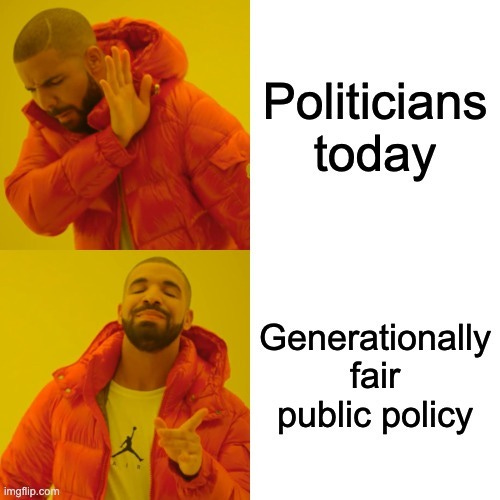
A generationally fair approach to public policy can provide a foundation for affordable housing and child care, healthy retirements, and wellbeing at all ages that will preserve what Canadians hold sacred for generations to come. Let’s not let our disappointment with politics today tarnish this long-term vision.
Indeed, the Liberal NDP coalition's increasing taxes on capital gains, 10-dollar day care, pharma care, dental care and plans to build more affordable housing are all progressive good moves towards a fairer sharing. Far from perfect but indeed substantial. The difference between that and PP's sloganeering-His social media posts, his 30 second videos on YouTube that are mere bumper stickers not solutions but aiming all of our resentments of unaffordability at one man, Trudeau. But these short-moronic takes that PP puts out there are effective in capturing the reactionary-unthinking vulnerabilities of the youth vote. It is very sad because it the very neoliberalism-cutting taxes and removing government from the housing market accelerated by Mulroney in the 1980s and carried through for decades that finds us with monopolies, oligopolies cornering the market able to price gouge-corporate greed- causing the unaffordability-causing a housing crises created by the market and government not having enough say. PP wants to cut taxes, cut down government-the very things needed for more fairness not to mention to have a planet that sustains life. I am not a big fan of Trudeau, but we need a population that at least can discern between a man trying to increase fairness and a man trying to aim all our resentments at one man. Listening to young voters telling Steve Paikin on TV Ontario's Agenda that they "loved PP's short videos, "he explains thing so well" left me feeling sick to my stomach, hoping that just enough of young voters have more time to think than scroll for the shortest most sensational takes. We shall see, but a populus that focuses on one man, that finds policy boring leaves us too dumb for democracy and getting the government we deserve.